

Bass Identification: Largemouth vs Smallmouth vs Spotted Bass
Learn to tell the difference between largemouth, smallmouth, and spotted bass. Key identification features for each species.
Bass are the most popular game fish in North America, but telling the different species apart can be tricky — especially spotted bass and largemouth. Here's how to identify each species at a glance.
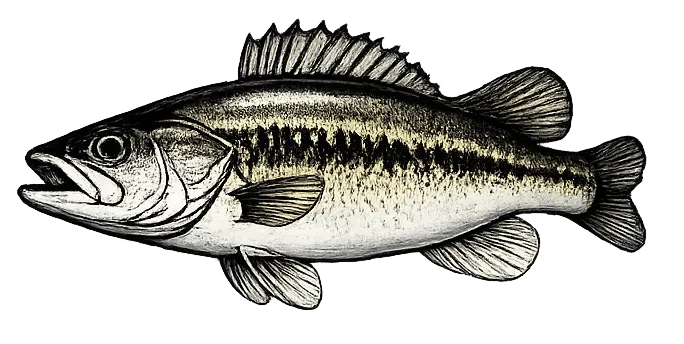
Largemouth Bass (Micropterus salmoides)
Range: Across most of the US and southern Canada
- Mouth extends past the eye — the most reliable identification feature
- Single dorsal fin with a deep notch between spiny and soft portions
- Dark horizontal stripe along the side (often broken or mottled in some fish)
- Colour: Olive-green to greenish-black on the back, lighter belly
- Upper jaw bone extends well past the rear of the eye
- Size: Typically 30-60 cm (12-24 in), up to 10 kg (22 lb)
Largemouth bass are the most widespread bass species in North America. They prefer warm, vegetated waters — lakes, ponds, slow-moving rivers, and reservoirs with abundant cover.
Smallmouth Bass (Micropterus dolomieu)
Range: Across most of the US and southern Canada
- Mouth does not extend past the eye — the key feature
- Bronze to brownish-green body with vertical dark bars rather than a horizontal stripe
- Red or orange eye in many populations
- Dorsal fin: Single fin with a shallow notch, first dorsal fin has 10-12 spines
- Upper jaw bone extends to about the middle of the eye
- Size: Typically 25-50 cm (10-20 in), up to 5 kg (11 lb)
Smallmouth bass prefer cooler, clearer water than largemouth. They're found in rocky lakes, rivers, and streams. They're known for their powerful fights and acrobatic leaps.
Spotted Bass (Micropterus punctulatus)
Range: Southeastern and central US, introduced in a few western states
- Mouth extends to about the rear of the eye — between largemouth and smallmouth
- Diamond-shaped dark spots on the belly (belly spots) — the most reliable feature
- Small patch of teeth on the tongue (largemouth and smallmouth don't have this)
- Colour: Olive-green with a light belly, rows of dark spots below the lateral line
- Dorsal fin: Connected with a shallow notch
- Size: Typically 25-45 cm (10-18 in), up to 4 kg (9 lb)
Spotted bass are often mistaken for largemouth bass. The key difference is the spotted belly and the smaller mouth that doesn't extend as far past the eye. They're native to the southeastern US but have been introduced in California and other states.
Quick Comparison
- Mouth past the eye = Largemouth Bass
- Mouth to the eye = Spotted Bass (check for belly spots and tongue patch)
- Mouth short of the eye = Smallmouth Bass
- Spots on the belly = Spotted Bass (not largemouth)
- Vertical bars on the side = Smallmouth Bass (not a horizontal stripe)
- Red eye = Smallmouth Bass
Fishing Tips for Each Species
Largemouth Bass
Target weed beds, lily pads, docks, fallen trees, and other shallow cover. Topwater lures, plastic worms, spinnerbaits, and jigs are all effective. Spring and fall are the best seasons.
Smallmouth Bass
Target rocky points, shoals, and islands in clear lakes and rivers. Tube jigs, drop-shot rigs, crankbaits, and topwater lures work well. Summer and early fall are prime.
Spotted Bass
Target similar habitat to largemouth — structure and cover in reservoirs and rivers. They often school in deeper water. Spotted bass are aggressive biters and will hit a wide range of lures.
Track Your Fishing with CatchTales
Identify every bass species you catch with the CatchTales app. The built-in fish identification guide covers 305 freshwater species across Canada and the United States.
← Back to BlogPublished July 2026 by the CatchTales team.

Written by Maison Louis Design — The Art of Better Digital
Get CatchTales
Ready to start bragging? Download the app and hit the water.
Free version available — upgrade to Pro for $8.99/year or $19.99 lifetime (CAD).